September 16, 2026

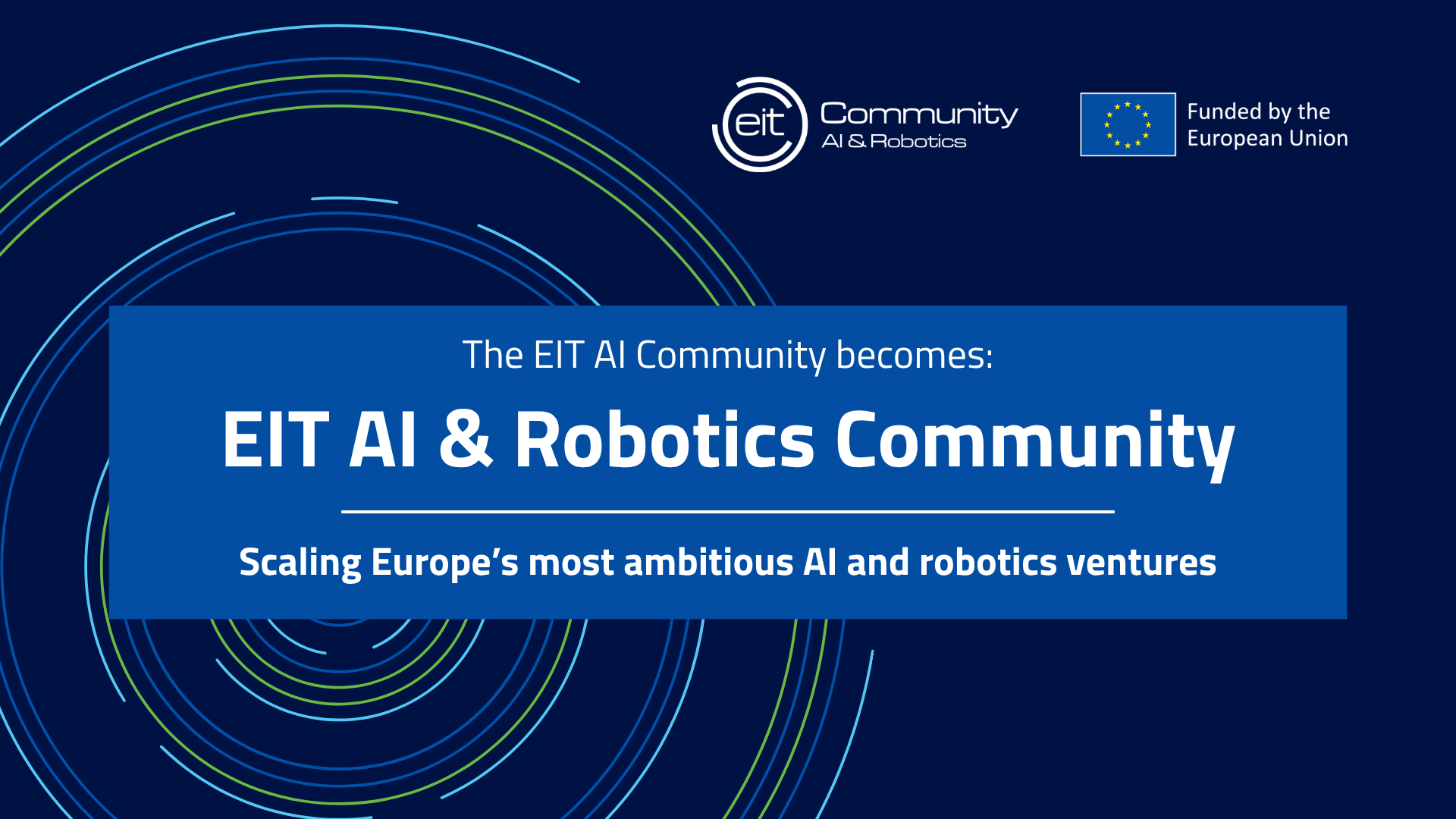
The EIT AI Community becomes the EIT AI & Robotics Community and opens its first call for founders 

The EIT AI Community is evolving into the EIT AI & Robotics Community, a pan-European initiative of the European Institute of Innovation and Technology (EIT), a body of the European Union, for 2026–2028. As part of this new direction, the initiative opens its first call - the AI Entrepreneurs Lab - for Europe's next generation of AI and robotics founders. A second call, FactoryX, will open in Autumn 2026.

This initiative exists to scale Europe's most ambitious AI and robotics ventures - from first idea to global scale - and to strengthen the continent's competitiveness and technological sovereignty in frontier and applied AI. It brings together multiple EIT Knowledge and Innovation Communities (KICs), led by 28DIGITAL with EIT Food, EIT Health and EIT Culture & Creativity, to turn Europe's research excellence into globally competitive companies across healthcare, manufacturing, food systems, biotechnology and robotics. Reflecting the current three-year EIT funding cycle, the initiative will run until 2028 and aims to launch 14 innovations, support more than ten high-potential scale-ups and help participating ventures leverage over €80 million in investment. 

An evolution: why robotics is now part of it 

The EIT AI & Robotics Community builds directly on the EIT AI Community. The change of name reflects the increasing convergence between artificial intelligence and robotics across Europe's innovation landscape, and a sharper focus on the journey from strong research capabilities to scalable, market-ready solutions. 

“Adding robotics responds to a specific gap. Europe produces world-class robotics research but struggles to turn it into deployed, commercial systems - particularly intelligent, AI-driven robotics operating in real industrial and physical-world environments. As AI and robotics increasingly converge, we support them together in the full path from research to market in exactly the applications where Europe's competitiveness and strategic autonomy are most at stake: from manufacturing and health to food systems and advanced sensing. In practical terms: we support AI and robotics founders with launching, scaling and funding their innovation.”  —  Orestis Trasanidis, Head of the AI & Robotics Community 

Open now: the AI Entrepreneurs Lab 

The AI Entrepreneurs Lab is a five-day founder bootcamp for Europe's next applied-AI and robotics founders, designed to move promising technical talent from the lab bench to the founder's seat. It is open to Master's and PhD students, graduates and early-stage founders with a strong AI or robotics idea (i.e. one where AI or robotics is central to the venture, such as industrial AI deployment or autonomous robotic systems). The cohort takes up to 15 participants, who may apply individually or as a team. 

Applicants are expected to show a clear problem, a credible technical direction and a plausible path to market, and to submit an application form, CV(s) and a short pitch. A full business plan is not required at this stage. 

Over five intensive, fully in-person days across Paris, Brussels and Amsterdam (9–13 November 2026), participants work with experienced founders on customer discovery, commercial-model testing and pitch development, and gain direct feedback from industry contacts and introductions to investors. Selected participants may receive travel and accommodation support, and up to five prizes of €10,000 are awarded on merit at Demo Day. 

Applications are open from 1 September to 21 October 2026 (17:00 CET).  

One connected pipeline, from first idea to global scale 

The initiatives' programmes form a connected pipeline, with different entry points and pathways for founders and ventures. The AI Entrepreneurs Lab builds talent, the Growth Studio funds and scales it, FactoryX proves it in industry, and the Founders Club opens global markets. 

  • AI Entrepreneurs Lab (open now) activates new founders and early teams. The strongest go on to receive prizes and progress into the AI Growth Studio, and the most promising are invited into the Founders Club — whether or not they win a prize. 
  • Growth Studio is the central venture-building engine, scaling the strongest early ventures with €100k–€200k tickets for pre-Series A core AI and robotics companies. 
  • FactoryX (opening Autumn 2026) brings startups together with industrial partners in co-funded consortium projects to validate advanced solutions in real operational settings. Its innovation owners feed into the Growth Studio. 
  • Founders Club connects Europe's top founders - many drawn from the Growth Studio and the Lab - to capital, corporates and global markets. 

Both the AI Entrepreneurs Lab and FactoryX therefore act as complementary entry points into the same pipeline - one bringing in new founders at the idea stage, the other bringing research–industry consortia at the validation stage - with the Growth Studio as the shared engine that scales what comes through. 

Turning Europe's regulatory leadership into an advantage 

The EIT AI & Robotics Community treats Europe's regulatory leadership as a competitive edge rather than a constraint, helping founders build trustworthy, compliant-by-design AI and robotics from the outset. For AI, that means designing to meet the EU AI Act from day one; for robotics, it means preparing for the regulatory frameworks that govern intelligent machines, such as the EU Machinery Regulation, which explicitly addresses AI-enabled machinery. This work aligns with EU priorities including the Apply AI Strategy, the Strategic Technologies for Europe Platform (STEP) and the EU Startup and Scaleup Strategy. 

July 10, 2025

New data shows AI innovation needs skills beyond coding

A groundbreaking new report co-authored by EIT Health and EIT Digital as part of the EIT AI Community reveals that Europe’s leading AI start-ups aren’t driven by coding skills alone – they thrive on a mix of deep sector expertise and interdisciplinary soft skills. The report includes regional data, key policy recommendations, and insights to support AI workforce development across Europe’s healthcare and innovation sectors.

The AI Skills and Occupations in the European Start-up Ecosystem report, powered by the EIT AI Community's SkillSync platform, analyses the skillsets of over 23,000 professionals across 3,600 AI start-ups. Its findings challenge conventional thinking about what fuels AI success in Europe. 

While strong foundations in programming and machine learning are widespread, the report highlights that start-ups combining technical know-how with sector-specific knowledge (e.g. in healthcare, engineering, or manufacturing) – and crucial soft skills such as communication and project management – are more likely to contribute to regional innovation. 

“Competence in general IT skills alone does not drive innovation. To truly unlock AI’s potential, we need to go beyond just digital skills and cultivate advanced, interdisciplinary capabilities that reflect the real-world needs and opportunities of each sector,” said Dr Magí Lluch-Ariet, Data Manager at EIT Health. 

This message aligns with Europe’s broader ambition to lead in AI, especially as the European Commission’s AI Continent Action Plan gains traction. The report’s findings offer data-driven recommendations for upskilling and aligning educational strategies across regions.  

Among the key insights: 

  • Healthcare and engineering skills boost performance: Regions with interdisciplinary capabilities consistently outperform others with similar technical baselines. 
  • Soft skills and sector understanding matter: Particularly in underperforming regions, these are often the missing link in innovation. 
  • Regulatory and audiovisual expertise is underrepresented: These areas remain critical bottlenecks in AI adoption, particularly in health. 

Using a new Skill Intensity metric, the report maps six regional skill clusters across Europe, allowing educators, policymakers, and corporates to benchmark workforce strengths and plan tailored upskilling programmes. 

The report suggests how local skills gaps could be addressed to drive innovation. For example, start-ups in Eastern Europe could benefit from a focus on multi-disciplinary ‘soft’ skills and sector-specific skills. This would allow them to build on their extremely solid base of skills, such as in ICT, which are extremely prevalent in AI start-ups, even if not correlated with regional innovation output on their own.  

In addition to supporting start-ups, EIT Health has long explored the implications of AI for the wider healthcare workforce. Its 2020 report, Transforming Healthcare with AI, highlighted the importance of preparing healthcare professionals for digital transformation. 

“Innovation doesn’t happen in isolation. At EIT Health, we see through our programmes that real impact comes from bringing education, research and business together in practical ways. This report reinforces that it’s not just about connecting these sectors – but about enabling the flow of skills between them. Whether it’s AI in healthcare or other cutting-edge technologies, the most successful innovations are driven by diverse, applied capabilities – technical, scientific, managerial – that our programmes are designed to nurture and deliver,” says Graham Armitage, Director of Delivery, EIT Health.  

🔗 Want to dive deeper? Discover how SkillSync is transforming learning and teaching through AI-powered skill matching. Join our webinar on July 23 to explore its latest features, datasets, and tools for educators, professionals, and organisations.

 👉 Reserve your spot

June 3, 2025

Paving the Way for the Next Generation of AI in Europe

Europe’s Growing AI Leadership

Europe is making significant strides in the field of artificial intelligence (AI), emerging as a global leader known for its commitment to excellence, trust, and forward-thinking leadership. The continent is witnessing advancements in digital transformation, business innovation and sustainable AI development. With undeniably strong momentum behind digital transformation, sustainable AI development, and business innovation, Europe is fostering one of the most dynamic innovation ecosystems in the world.

Building a Responsible and Ethical AI Ecosystem

At the heart of this transformation lies Europe’s dedication to building a responsible AI future. By integrating ethical frameworks and a human-centric approach, Europe is setting a global benchmark for trustworthy AI. This emphasis is reinforced by robust research institutions, cutting-edge startups, and a collaborative spirit between public and private sectors.

Talent as a Cornerstone of Innovation

One of Europe's key strengths is its deep talent pool and comprehensive support for AI education. Across the continent, universities, research centers, and training programs are equipping future professionals with the skills necessary to lead in a fast-evolving digital landscape. However, challenges remain. Growing labour shortage and widening skills gap threaten to slow down progress and limit the capacity for innovation.

Closing the Skills Gap

In order to address this, the European Institute of Innovation and Technology (EIT) is stepping in with a proactive strategy. Through its AI-focused community initiatives, EIT AI Community offers targeted tools, training programs, and resources. They are precisely designed to nurture AI talent, support startups, and enable scale-up efforts across the continent.

Connecting Europe’s AI Ecosystem

These efforts are grounded in a solid understanding of market needs and driven by a vast, interconnected European network. The EIT AI Community is shaping the future by supporting current innovation. Likewise, by empowering entrepreneurs, upskilling workers, and fostering collaboration across industries and countries, the community is creating fertile ground for AI development and adoption.

Join the Movement

Now is the time to engage. Join the movement to shape the next generation of AI in Europe - where innovation meets impact, and talent meets opportunity.

V- comm + Artificial + fundedvector-2